
Subfloor Boards: Choosing Sheathing for Laminate and Vinyl
A subfloor is the layer nobody sees and everybody walks on, and CDX pine sheathing is built for exactly that invisibility. Dongstar Wood defines its CDX sheathing as a C-grade face, a D-grade back and Exterior glue, with cross-laminated pine veneers that reduce warping and splitting under load.
Key takeaways
- CDX means a C-grade face, a D-grade back and Exterior (X) glue — construction-grade by definition.
- Cross-laminated pine veneers reduce warping and splitting under load.
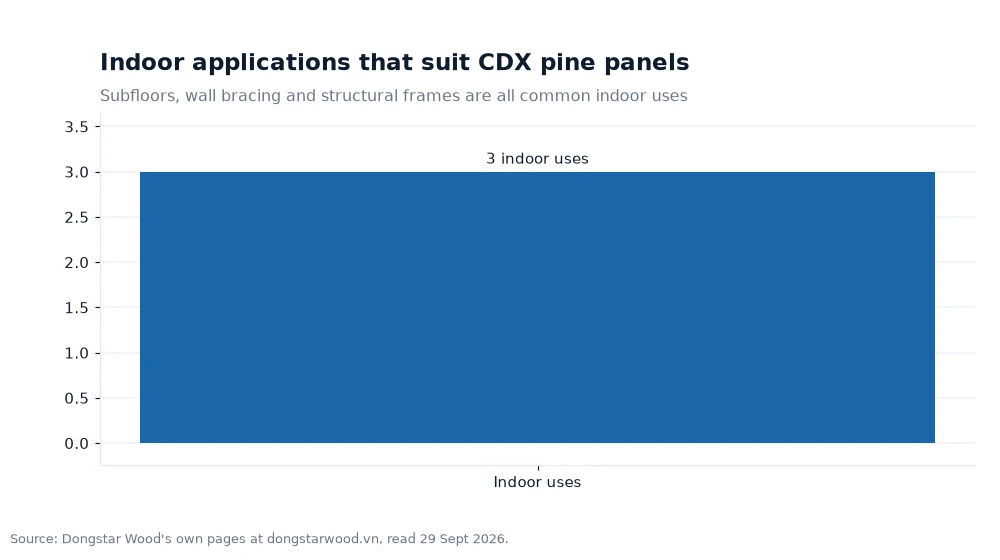
- Indoor uses include subfloors, wall bracing and structural frames; exterior glue resists moisture during construction.
- The panel is not waterproof and is not suited to permanent weather exposure.
What the letters mean
CDX is a code, not a brand: C is the face grade, D is the back grade, and X stands for Exterior, meaning the glue line is built for exposure. Dongstar Wood defines its CDX sheathing as a C-grade face, a D-grade back and Exterior glue, with cross-laminated pine veneers that reduce warping and splitting under load. The face is sound and smooth, with variation allowed, and the back faces the joists, where the grade matters even less. The Exterior glue is the part that does the work: it keeps the veneer layers bonded through the moisture a subfloor meets.
The definition matters because it sets expectations honestly. This is construction-grade sheathing: the face will not be pretty, the back will not be pretty, and the panel will be flat, stiff and bonded. For a subfloor under laminate or vinyl, that is the complete requirement.
Subfloors under laminate and vinyl
A laminate or vinyl floor is only as good as the subfloor beneath it. The finish floor is thin, rigid and unforgiving: every ridge, gap and movement in the sheathing shows up as a click, a rattle or a visible line within a year. The sheathing's job is to be flat, continuous and stable, and the cross-laminated pine veneer structure is what delivers that — the alternating grain direction reduces warping and splitting under load.
The page names subfloor and underlayment under carpet, laminate and vinyl among the applications. In each case the panel is the hidden layer that carries the finish, and the choice between carpet, laminate and vinyl changes what the finish demands of the subfloor, not what the subfloor demands of the panel.
Indoor uses beyond the floor
Indoor use is common on this range: subfloors, wall bracing and structural frames are all named. Wall bracing is the hidden structural use — the panel is fixed to the studwork and forgotten, carrying racking loads for the life of the building. Structural frames are the same idea at larger scale, where the panel's stiffness replaces a heavier section.
These uses share one property: the panel is covered, fixed and expected to stay put. The Exterior glue is not wasted on them, because the same moisture resistance that protects a subfloor during construction protects a frame through the building's lifetime. A braced wall panel is fixed once and inspected never, so the bond has to hold for decades rather than for a season.
Roof decking, sheathing and temporary work
Also named on the page: roof decking, shingle and tile underlayment, exterior wall sheathing, plus construction barriers and temporary structures — hoarding, fencing and temporary floors on site. These outdoor-adjacent uses come with a clear caveat: the panel is not waterproof, and the limit belongs in the specification. During construction phases the Exterior glue resists moisture and rain, but the panel is not suited to permanent exposure to weather — a roof deck that will be covered within the programme is a legitimate application, and a panel left through a winter is not.
That distinction is the whole specification question for outdoor work. A roof deck that will be covered within the construction programme is a legitimate CDX application; a panel left exposed through a winter is not. The glue resists moisture, the veneers do not.
Crating and industrial packaging
Heavy-duty crates and pallets round out the application list, and they are the uses where the C-grade face and the Exterior glue earn their keep together. A crate is handled, dropped, stacked and rained on, and it is also expected to look like nothing in particular. Construction-grade sheathing is the honest material for the job.
The same logic applies to temporary floors on site: a floor that will be covered, removed or replaced does not need a face grade, it needs flatness and bond. CDX is specified for the life of the task, not the life of the building. A crate that is dropped, stacked and rained on asks the same two things of the panel, which is why the construction-grade definition travels so easily between the two applications.
| CDX component | Published definition | What it provides |
|---|---|---|
| Face | C-grade face | Sound, smooth, construction-grade |
| Back | D-grade back | Structural, hidden face |
| Glue | Exterior (X) | Moisture resistance during construction |
| Structure | Cross-laminated pine veneers | Reduced warping and splitting |
| Limit | Not waterproof | No permanent weather exposure |
Worked example: a subfloor from sheet area
Area arithmetic sizes a subfloor before the boards are ordered. A room 8 m by 5 m is 8 × 5 = 40 m². One 1220 × 2440 mm sheet covers 1.22 × 2.44 = 2.9768 m², so the room needs 40 ÷ 2.9768 = 13.44 sheets — 14 boards before cutting loss. Add 5% for waste and the order is 15 sheets.
The same arithmetic checks the finish floor. A laminate that clicks over a ridge will telegraph it, so the subfloor is checked for flatness after laying, not before ordering. The panel count does not change; the inspection does.
Frequently asked questions
What does CDX stand for?
C is the face grade, D is the back grade, and X stands for Exterior, meaning the glue line is built for exposure. It is a construction-grade definition, not a brand name.
Can CDX pine plywood be used outdoors?
For construction phases, yes — the Exterior glue resists moisture and rain while the building is going up. The panel is not waterproof and is not suited to permanent exposure to weather, so it should be covered within the programme. The distinction is between a construction phase and a service life, and the specification should say which one the panel is being bought for.
What indoor uses suit CDX panels?
Subfloors, wall bracing and structural frames are all named indoor uses. The panel is covered, fixed and expected to stay put, which is exactly what construction-grade sheathing is built for.
Specifying the hidden layer
The subfloor is specified with the same care as the finish floor, because it is the finish floor's foundation. Read the CDX Pine Plywood page for the grade, glue and structure definitions, then check the company profile for the factory behind them. Where the same project also needs safe walking routes at height, the wire mesh range covers the anti-slip duty. The floors that stay quiet underfoot are the ones laid on a carefully specified subfloor layer that was ordered on purpose.
Statistics quoted above were sourced from the vendor's online documentation accessed 29 Sept 2026[1].