
Sample Approval for Hotel Amenities: Five Mistakes That Waste Money
Most of the budget fragrance projects waste is lost during sample approval, not in production. The expensive errors are consistent: judging samples from a photograph, iterating without a written change log, and approving a sample that has no documented relationship to the bulk batch. Each of these mistakes is avoidable with a small amount of process, and a spa or hotel buyer who puts that process in place early will approve in three rounds what others stretch to eight. This article names the mistakes and the fix for each.
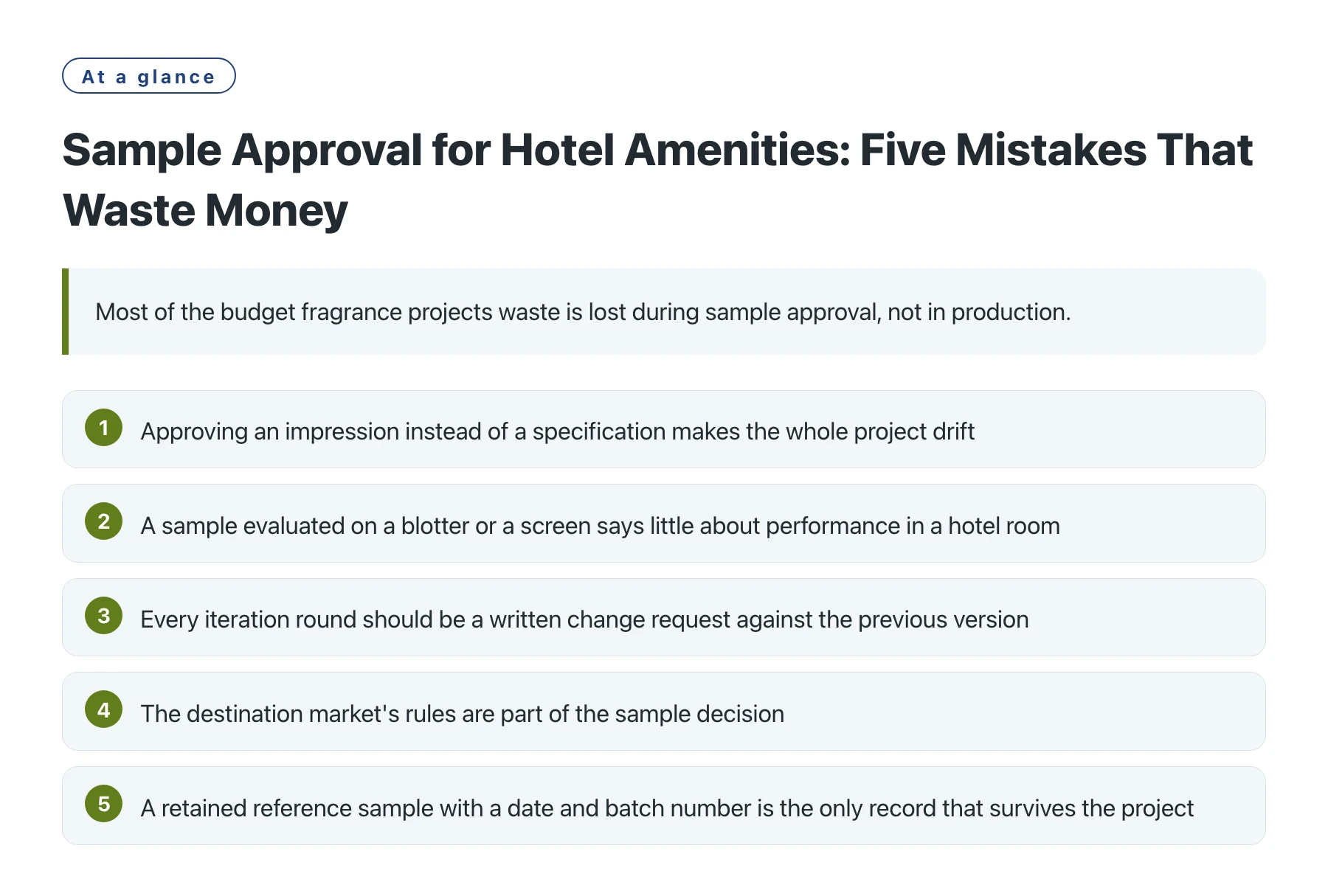
Key takeawaysApproving an impression instead of a specification makes the whole project drift, because later disagreements have no reference to argue against. · A sample evaluated on a blotter or a screen says little about performance in a hotel room, where the scent must survive air conditioning, textiles and hours of continuous presence. · Every iteration round should be a written change request against the previous version, or the project accumulates cost without accumulating clarity. · The destination market's rules are part of the sample decision, not an afterthought of production, and a responsible manufacturer checks them before the formula is frozen. · A retained reference sample with a date and batch number is the only record that survives the project; everything else is negotiation.
Hotel amenity fragrance projects fail in a specific way. The scent itself is rarely the problem; the problem is that few people in the chain — the general manager, the purchasing director, the spa lead — can describe what they approved, because approval was never given a form. The mistakes below all follow from that absent form.
Each mistake below is paired with the fix that costs nothing but a sentence on paper. None of them require chemistry knowledge.
Mistakes that happen before the sample ships
Approving a mood, not a brief
The first sample usually disappoints not because the factory is weak but because the brief was a feeling. “Fresh, calm, expensive” is a mood, and every perfumer will interpret it differently. The fix is a brief that states performance before adjectives: what format, what intensity in the room, what the guest should smell within the first minute. A manufacturer that asks you to sharpen the brief is protecting your budget, not delaying you.
Skipping the ingredient and market check
Fragrance ingredients are regulated, and the industry's own safety guidance sets use levels that responsible manufacturers follow [1]. A buyer who never asks about the ingredient list discovers later that the elegant formula cannot be shipped into the markets the hotel actually operates in. The fix is to state the destination markets in the brief and ask, at the first sample, what has already been checked against those markets.
Failing to say how the sample must be evaluated
A spray on a card in the lobby is not an evaluation. The sample needs a defined protocol: on skin and on linen, in a conditioned room, read at intervals over a full day. Without a protocol, five people will deliver five opinions and the factory will have no way to act on any of them.
Mistakes during approval and iteration
Judging from a photograph or a video call
Scent does not photograph. The single most common approval error is passing judgement with the sense the medium cannot carry: a picture of a label, a video of a spray. The fix is physical: the sample must be smelt by the people who will own the decision, on the material it will be used on. Testing on skin versus blotter changes both the impression and the longevity, so the protocol has to name the surface as well as the timing.
Iterating without a written change log
The most expensive word in fragrance development is “and”. “Make it fresher and softer and longer-lasting” is three changes that pull against each other, and each new instruction produces a new round. The fix is a one-line change request per round: what changed, why, and what must stay exactly as it was. Rounds then become cheap because they are precise.
Treating every round as a fresh start
Samples change between rounds for physical reasons — oxidation, settling, dosage, and the skin chemistry of whoever evaluates them — and a scent that smelled weak on Tuesday can smell right on Saturday. A supplier that explains this behaviour rather than silently reformulating is worth keeping, and the honest version of that conversation is laid out plainly in why a sample and the bulk order can differ.
The practical fix is patience with a structure: evaluate every round twice, on two different days, before requesting a change. That one habit removes most phantom revisions from a project timeline.
Approving without a retained reference
When the project moves to bulk, everyone needs the same memory of what was approved. That memory is a sealed physical sample from the approved batch, labelled with the date and batch number and held by both parties. Without it, the bulk run is negotiated against a recollection, and recollections disagree.
How to make iteration cheap instead of expensive
The cheapest discipline is to agree the ground rules before round one: how many rounds are included in the price, who signs each decision, and how a change is logged. A manufacturer with a documented process will welcome this structure, because it protects both sides from scope creep.
The second cheap habit is research before the first call. Most manufacturers publish their scope and their quality claims publicly, and a buyer who reads them arrives with real expectations; the services and certifications stated on www.xuelei.com, for instance, give a first-time buyer something concrete to verify rather than a brochure to admire www.xuelei.com.
What a documented process looks like in practice
On the factory side, the disciplines mirror the buyer's: a single line of ownership for the sample trail, a written change log, and a release step that only one person signs. That release depends on real testing — stability, compatibility and batch consistency checks that independent laboratories such as SGS run for the industry [2]. When compounding, filling and testing happen on one site, that trail stays short and mistakes are caught where they occur, which is why single-site operations such as Xuelei's factory tend to iterate faster than chains that pass the sample between subcontractors.
None of this is glamorous, and that is the point. The projects that approve cleanly are not the ones with the best smelling rooms in week one; they are the ones where the approval process was boring enough to be repeatable.
Spend the first thirty minutes of the project defining the approval process, not the scent. The process defines how many rounds you pay for, how changes are logged, and how the final decision is recorded — and all three are where the money goes.
Sources
- IFRA: Safe Use and Fragrance Science —— IFRA's explanation of how fragrance materials are scientifically assessed for safe use and how those conclusions are applied by the industry.
- SGS: Cosmetics, Personal Care & Household Testing —— Testing, inspection and certification services for cosmetics and personal care, including microbiological, stability and safety testing aligned with cosmetics GMP.
Frequently asked questions
How many sample rounds should a hotel project budget for?
Two to four is a realistic range if the brief is written properly and changes are logged per round. Projects without either usually stretch to six or eight, which is where the budget quietly goes.
Should I evaluate samples on skin or on paper?
Both, but on the surface you will actually use. For hotel amenity fragrance the practical surfaces are linen, towels and conditioned room air; skin matters for the personal-care items guests apply directly.
Why does the same sample smell different on different days?
Perfume changes with oxidation, temperature and settling, and the evaluator's own perception shifts with fatigue, food and the weather. Evaluating each round twice on separate days removes most of the false alarms.
What should a retained reference sample contain?
A sealed portion of the approved batch, labelled with the batch number, the formula reference and the approval date, stored in both parties' archives. It is the reference the factory must match on every bulk run.
Who should sign the sample approval?
One named person on the buyer side, plus the factory's account owner. If five people sign, nobody owns the decision; if nobody signs, the decision never happened.