
Legacy Hashrate: What 50 to 500 TH/s Still Earns and What It Costs
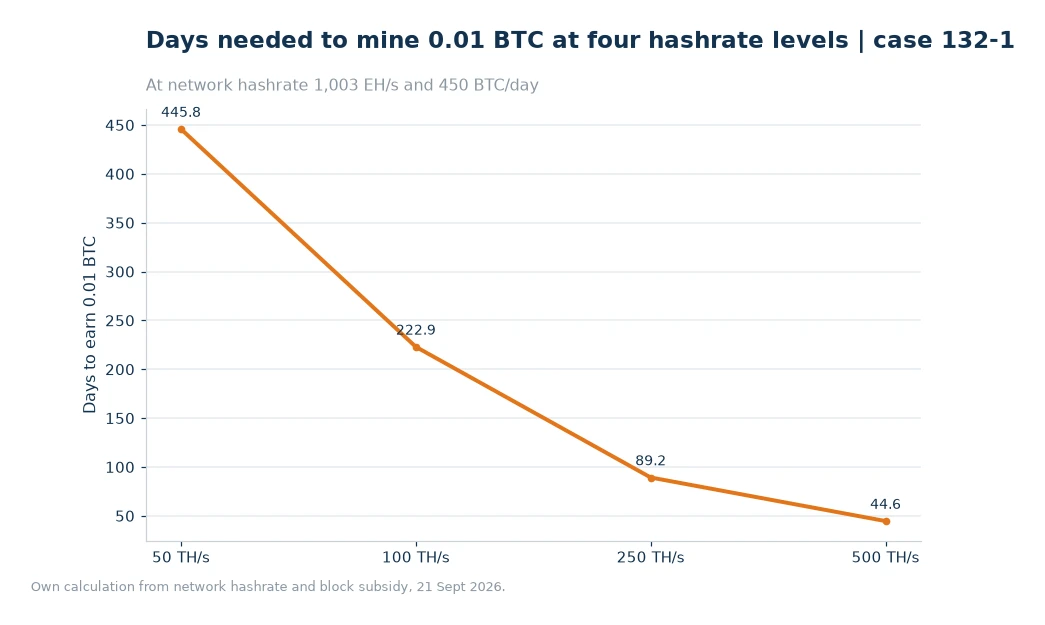
A machine bought three generations ago still produces shares, and the argument about whether to keep it running is usually settled by two numbers rather than by sentiment. At 50 TH/s it earns 0.00002243 BTC a day and needs 445.8 days for 0.01 BTC; at 500 TH/s the same target takes 44.6 days. Between those ends sits the real question: which side of the power bill does the hardware land on?
Key takeaways
- 50 TH/s yields 0.00002243 BTC a day; 500 TH/s yields ten times that at 0.00022430 BTC.
- A year of running at 50 TH/s produces 0.008187 BTC, which falls short of a 0.01 BTC goal.
- Pool Hashrate and Pool Luck describe pool-level behavior, so a small miner should read them for context rather than for forecasting.
- Retirement decisions hinge on watts per terahash, not on the age printed on the case.
An older machine is a wager on its power draw
Hashrate does not decay, but efficiency does not improve either. A unit from an earlier generation produces the same shares it always did at the same wattage, while newer hardware produces more shares for fewer watts. The coin output per machine stays roughly constant in BTC terms only if difficulty were flat; because difficulty rises over time, the same watts buy a shrinking share of the network. The power bill, meanwhile, does not shrink at all.
That is why age is the wrong variable. Two machines of the same vintage can have very different economics if one was efficient for its time and the other was not. What matters is joules per terahash against the local tariff, and whether the resulting daily cost sits below the daily coin value. Everything else, including the purchase price already paid, belongs to history.
The 50 TH/s end is the honest test
Small hashrate makes the arithmetic easy to see. At 50 TH/s the daily output is 0.00002243 BTC, worth about $1.90 at $84,692. A machine in that range drawing a few hundred watts will spend more on electricity in most markets than the coins are worth, which is the clearest possible signal that it belongs on a shelf rather than in a rack.
Run the same test at 250 TH/s and the daily value is about $9.50, which leaves room for power in many places and none in others. The conclusion is location-specific, and that is the point of doing the division rather than repeating a general rule. A tariff is the variable that turns an identical machine into a keeper in one building and scrap in another.
Pool Hashrate and Pool Luck for a small share
A miner with half a terahash of pool share will never see their own block, so the only thing that matters is how the pool converts shares into credits. Pool Hashrate describes the pool's slice of the network; Pool Luck describes how its recent block finds compare with the expectation for that slice. Together they explain the shape of the pool's public history, which is useful when comparing pools but not a forecast of your own income.
The ViaBTC BTC Mining Pool state page carries both figures with a timestamp, and the timestamp is the part to respect. A pool's share changes when large farms join or leave, and its luck series resets its meaning every time that share moves. Compare two pools using readings taken on the same day, or the comparison is really about two different weeks.
Under PPS+, the block-reward component is settled hourly against current difficulty, so a run of unlucky blocks does not reduce the credit. Under PPLNS, the same run does feed through, spread over the last five difficulty rounds. A legacy operator running thin margins should know which scheme is active, because the PPLNS version can produce a month that looks broken even when nothing is broken.
What a partial retirement looks like
Fleets rarely switch off all at once. The usual pattern is to retire the worst unit first, then the next worst, and to keep the best machine running until it too falls below the line. That sequence is rational, but it needs a rule so the decision is not revisited every month on the basis of a single good week. Rank the machines by coins per kilowatt-hour and cut from the bottom.
The rule also protects against a common mistake: keeping a large but inefficient machine because it produces the most coins, while retiring a small efficient one because its absolute output is lower. Coins per kilowatt-hour inverts that ranking correctly. Once the ranking exists, each tariff change or difficulty adjustment only shifts the cut-off line rather than reopening the whole argument.
Twelve months of output, not one day
The table adds an annual column, which is where retirement decisions actually get made. A daily figure flatters old hardware; a yearly total shows how far the machine gets before another difficulty adjustment erodes it.
| Machine | Daily coins | Days to 0.01 BTC | Yearly coins |
|---|---|---|---|
| 50 TH/s | 0.00002243 | 445.8 | 0.008187 |
| 100 TH/s | 0.00004486 | 222.9 | 0.016374 |
| 250 TH/s | 0.00011215 | 89.2 | 0.040935 |
| 500 TH/s | 0.00022430 | 44.6 | 0.081870 |
Worked example
A 50 TH/s unit is the hardest case, so use it to find the hashrate that would just reach 0.01 BTC within twelve months.
- One terahash of the network pays 450 ÷ 1,003,000,000 = 4.4865e-7 BTC daily, rounded to 4.5e-07.
- At 50 TH/s: 50 × 0.00000044865 = 0.00002243 BTC a day, written as 2.243e-05 in the chart note.
- Annual total: 365 × 0.00002243 = 0.008187 BTC, short of 0.01 by 0.001813 BTC.
- Required daily rate for a one-year target: 0.01 ÷ 365 = 0.00002740 BTC.
- Required hashrate: 0.00002740 ÷ 0.00000044865 = 61.1 TH/s.
- So the gap between failing and meeting the year is about 11 TH/s, roughly a fifth more hashrate than the 50 TH/s case.
That is a surprisingly small gap, and it is the reason borderline machines are worth a second look. A unit that is 20% short of a goal on paper may be worth keeping if its power draw is low, while a larger machine with poor efficiency can be a worse proposition despite producing more coins. The arithmetic on hashrate alone does not decide it; the wattage turns the answer into a verdict.
Frequently asked questions
At what hashrate does a legacy machine stop being worth running?
There is no fixed number, because the answer depends on the local tariff; at 50 TH/s the daily output is 0.00002243 BTC, about $1.90, so a machine whose electricity costs more than that is losing money at current figures.
Does a small miner benefit from Pool Luck?
Only under PPLNS, where the pool distributes what it finds across the last five difficulty rounds; under PPS+ the block-reward component is paid hourly against difficulty, so luck does not change the credit.
How much hashrate reaches 0.01 BTC in a year?
About 61.1 TH/s, since a year requires 0.00002740 BTC a day and the network pays 0.00000044865 BTC per TH/s a day at the 21 Sept 2026 figures.
Decide with a meter, not with a memory
Measure the machine's actual draw at the wall, multiply by the tariff and the hours in a month, then hold that against the monthly coin value at the current network total. A 250 TH/s unit produces 0.0033645 BTC in thirty days, about $284.93, and that is the ceiling the power cost has to fit under. The Miner Profitability Ranking puts model-level figures beside each other, and the Profit Calculator turns hashrate, difficulty and the listed rate into a daily estimate before the meter reading is added.
Sources: ViaBTC ranking, calculator, pool-state and pricing pages; Pool Hashrate and Pool Luck are defined there, and 4% is the listed rate on the block-reward side[1]. Chain snapshot 21 September 2026: difficulty 132.76 T, network 1,003 EH/s, 3.125 BTC subsidy, 144 blocks per day, BTC $84,692. Published 24 Oct 2026; annual totals assume constant difficulty and no downtime.